
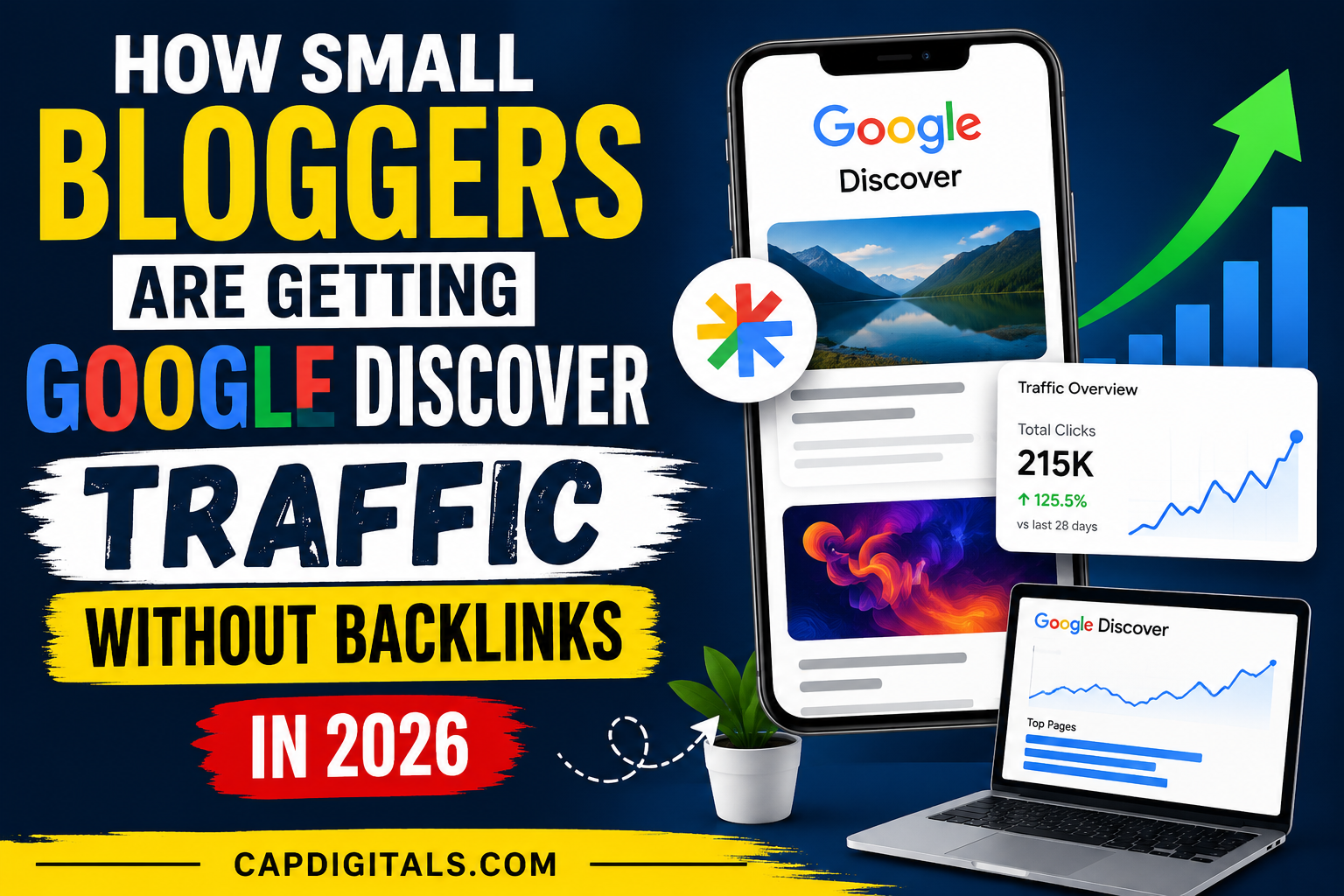
Google Discover Traffic is becoming one of the biggest opportunities for small bloggers in 2026. Let’s be brutally honest. Traditional Google SEO is becoming a nightmare for small publishers.
Let’s be brutally honest. Traditional Google SEO is becoming a nightmare for small publishers. You target a great keyword, wait months for it to rank, and then a massive multi-million dollar media site steals your spot simply because of their high domain authority. It’s frustrating, slow, and completely exhausting.
But in 2026, a different game is happening. A small group of independent bloggers is pulling millions of views out of nowhere. No expensive SEO software, no massive budget, and zero traditional backlink building.
They are doing it by tapping straight into Google Discover.
Tiny niche websites with almost zero brand authority are suddenly outperforming the internet giants. Why? Because Discover doesn’t care about the old SEO rulebook. It runs on a completely different algorithm focused on fresh trends, visual hooks, and real human engagement. Here is the exact breakdown of how to decode it this year.
The Big Difference: Search Intent vs Recommendation Feeds
The biggest mistake beginners make is treating Google Discover like normal search. They are two entirely different systems.
Many small publishers are now focusing heavily on Google Discover Traffic because it can generate sudden traffic spikes without relying entirely on traditional search rankings.
Normal SEO relies completely on someone typing a specific query into a search box. Google looks at keywords, technical optimization, and backlink profiles to rank the answer. It’s a pull system.
Discover is a push system. It acts exactly like a personalized social media feed. It tracks what users are browsing, what topics they care about, and what is currently trending, then pushes articles directly onto their mobile screens. Your post doesn’t need to be on page one of Google to explode; it just needs to click with a user’s current interest.
Why Speed is Smashed by Smaller Websites
Big corporate websites have a major weakness—they move too slowly. An article has to go through editors, legal teams, and proofreaders before it sees the light of day. By the time they publish, the trend is already over.
As an independent blogger, speed is your ultimate weapon. You can spot an emerging topic on X (Twitter), Reddit, or Google Trends, compile a high-quality post, and get it live within an hour. Discover loves immediate freshness. If you are the first to provide a solid report on a breakout topic, the algorithm will pick it up and push it to millions before the media giants even wake up.
The biggest advantage of Google Discover Traffic is that even newer websites sometimes receive visibility if their content matches trending audience interests.
The Metric Shift: Why Backlinks Take a Backseat
Do backlinks help your site’s overall health? Yes. But inside the Discover ecosystem, user behavior signals matter way more than your link profile.
Google’s recommendation artificial intelligence prioritizes how live users interact with your link over how many sites link to you. The algorithm watches specific metrics:
- Click-Through Rate (CTR): Are people actually tapping your headline when it shows up in their feed?
- Dwell Time: Do they stay on the page to read, or do they bounce back immediately?
- Scroll Depth: Are they scrolling down to see your formatting and images?
If a small blog writes an incredibly engaging piece that keeps people reading for three minutes, Discover will continuously push it over a boring, corporate article from a high-authority site.
Visuals Are the Ultimate Gatekeeper
Think about how you scroll through your own phone. You make a decision to click in less than a second. Your featured image is the single most important factor determining your Discover success.
The successful creators in 2026 aren’t using boring, generic stock photos anymore. They use high-contrast graphics, bold text overlays, and vivid mobile-optimized framing. A boring image will kill a brilliant article. If your CTR is low, Discover will drop your link into the graveyard within hours. Invest time into your thumbnails; it makes or breaks the traffic spike.
The Death of the Unedited AI Spam Farm
Everyone is trying to automate blogging right now using raw AI generators. They publish fifty unedited posts a day and wonder why their traffic remains at zero.
Discover is heavily fine-tuned to detect low-effort AI spam. Why? Because automated content usually lacks depth, real screenshots, personal voice, and unique opinions. Users bounce from those pages instantly, which signals Google that the content is junk.
The winners use a hybrid workflow. They use AI to handle rapid topic research, data sorting, and fast outlines. But the actual writing, the storytelling, the personal analysis, and the unique screenshots are handled manually. Real humans read your content, and if it feels natural, they stay longer.
Stop Chasing One-Hit Wonders: Build Topical Ecosystems
Discover traffic is notoriously unpredictable. An article might bring you 40,000 clicks in 24 hours and then vanish completely the next morning. That is completely normal.
The blogs that survive don’t rely on a single viral hit. They build tight clusters of content around specific categories like:
- SEO strategies and search tracking
- Practical AI tools and workflow automation
- Affiliate marketing case studies for beginners
- Digital product layouts and traffic generation
When you publish consistently inside one category, Google learns exactly who your site is for. Once the system registers your topical authority, it becomes way easier for your next post to drop straight into the feeds of users interested in that exact niche.
Unlike old-school SEO methods, Google Discover Traffic depends more on engagement signals, visuals, freshness, and user behavior patterns.
If you want long-term Discover growth, building a proper content ecosystem matters more than chasing random viral spikes. Many successful creators are now combining ChatGPT + Pinterest traffic strategies with Discover-focused publishing to diversify their audience sources.
Google also appears to reward websites that maintain strong topical consistency. Instead of publishing random unrelated articles, smart bloggers are building structured content cluster strategies that help search engines understand their expertise more clearly.
Another major ranking factor quietly shaping Discover visibility is topical authority. Websites consistently covering SEO, AI tools, blogging, and digital marketing often gain stronger recommendation signals over time.
Many independent publishers are also adapting quickly to the latest Google AI updates affecting small bloggers, especially as search behavior continues shifting toward AI summaries and recommendation feeds.
At the same time, creators need to understand how zero-click searches are changing traditional SEO traffic patterns. This is one of the biggest reasons why Discover traffic is becoming more valuable for modern websites.
Recommended External Resources
- Google Trends — Track emerging breakout topics and Discover-friendly trends.
- Google Discover Guidelines — Official documentation explaining Discover content policies and recommendations.
- Google Search Console — Monitor Discover impressions, clicks, CTR, and indexing performance.
- Google PageSpeed Insights — Analyze mobile speed performance and Core Web Vitals.
- Google News Initiative — Learn more about content quality, journalism signals, and publishing best practices.
Common Traps That Kill Your Feed Eligibility
Want to stay in Google’s good books? Avoid these basic mistakes that trigger immediate algorithmic penalties:
- Using cheap, misleading clickbait titles that don’t deliver on their promise.
- Overloading your site with intrusive pop-up ads that ruin the mobile reading experience.
- Publishing thin, repetitive content that just rehashes old news.
- Ignoring your site’s mobile loading speed—if it takes more than three seconds to open, the user is gone.
Bloggers who consistently optimize their headlines and feature images often improve their Google Discover Traffic performance significantly.
Final Thoughts by Capdigitals
The digital publishing landscape isn’t shrinking; it’s just changing format. The bloggers winning the traffic game in 2026 aren’t the ones with the deepest pockets or the oldest domains. The future belongs to the agile creators—the ones who spot a trend, write like a human, use killer visuals, and hit publish before anyone else can react.
For more raw blogging strategies, traffic blueprints, and digital growth tactics that actually move the needle, keep checking back on Capdigitals.com.

Adeeb Malik is the founder of Capdigitals, where he shares practical insights on digital marketing, blogging, SEO, and online earning. He focuses on simplifying complex strategies into easy, actionable steps for beginners. The content is based on research, real-world concepts, and learning resources. All information is for educational purposes only and does not constitute financial or business advice.