
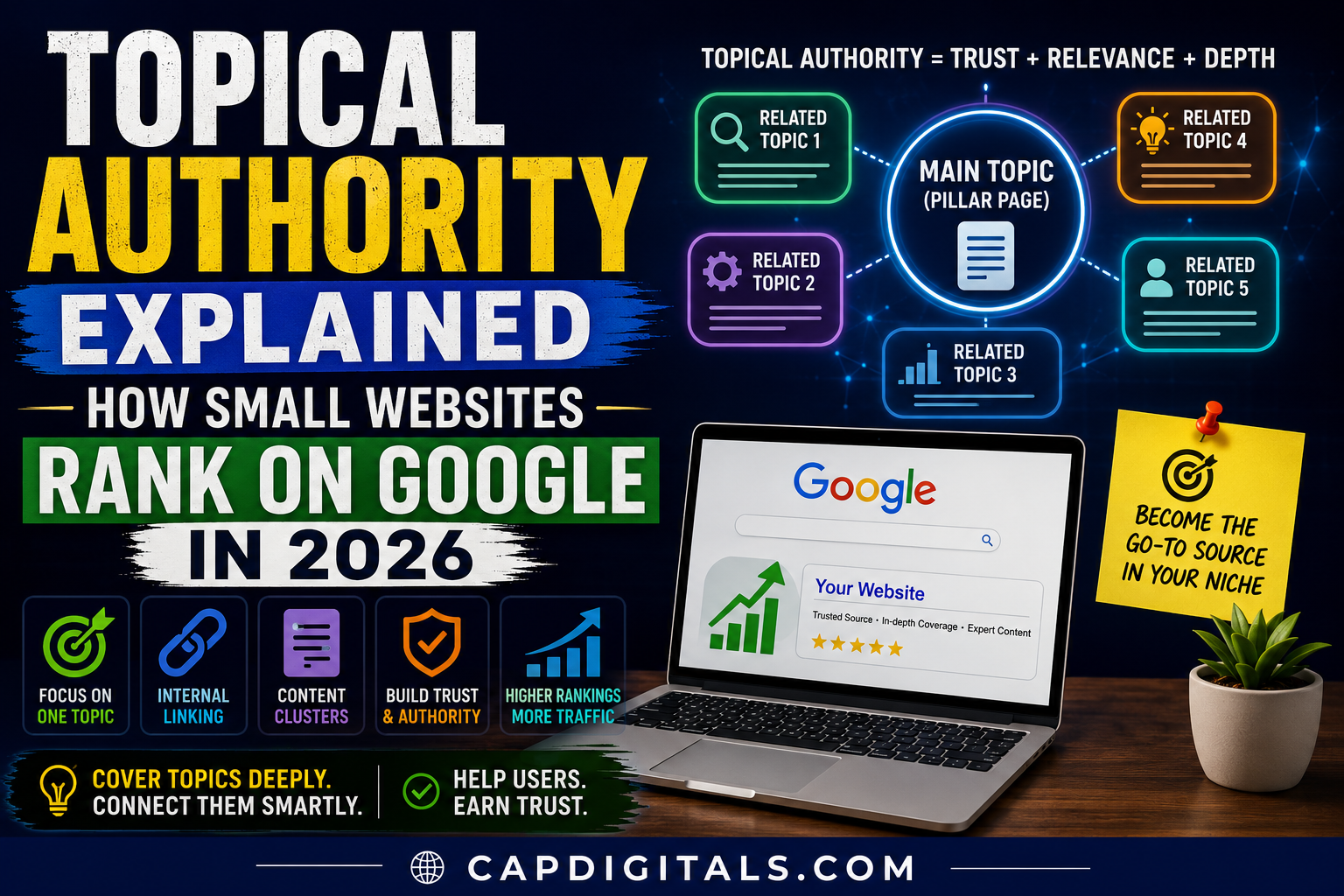
Topical Authority is becoming one of the most important concepts in modern SEO.
A few years ago, many websites could still rank by publishing random articles around low-competition keywords. Some bloggers focused heavily on quantity, quick SEO tricks, and mass content publishing.
For a while, those strategies worked surprisingly well.
But in 2026, Google’s search systems are evolving rapidly.
AI-powered search, Google AI Overview, zero-click results, and stricter quality systems are changing how websites gain visibility online.
And honestly, many smaller websites are now struggling because Google increasingly wants to rank trusted topic experts instead of websites publishing disconnected content purely for traffic.
That is exactly where topical authority becomes important.
What Is Topical Authority?
Topical authority simply means becoming a trusted source around a specific subject or niche.
Instead of publishing random unrelated articles, websites build authority by deeply covering connected topics in a structured way.
For example, a website focused on:
- SEO
- AI search
- blogging
- affiliate marketing
- digital marketing
naturally creates stronger topical relevance compared to a general website posting about completely unrelated subjects every day.
In simple words:
Google wants to understand what your website is truly about.
And topical authority helps search systems trust that expertise much more clearly.
Why Topical Authority Matters More in 2026
Search engines are becoming smarter every year.
Google no longer looks only at:
- keywords
- backlinks
- meta tags
- basic SEO optimization
Those things still matter.
But modern search systems increasingly evaluate:
- content depth
- topic coverage
- website trust
- content relationships
- user value
AI-generated content has also changed the internet dramatically.
Thousands of websites now publish repetitive articles daily using AI tools.
Because of this, Google needs stronger ways to identify genuinely trustworthy websites.
And honestly, topical authority has become one of the strongest trust signals available.
How Google Understands Website Authority
Google tries to understand websites the same way humans understand expertise.
For example:
If someone talks consistently about:
- SEO strategies
- Google updates
- AI search
- blogging growth
over a long period of time, they naturally appear more knowledgeable in that area.
The same thing happens with websites.
When websites publish multiple strong interconnected articles around one niche, search systems begin understanding:
- what the website specializes in
- which topics it covers deeply
- how articles relate together
That creates stronger authority signals.
Why Random Blogging Is Becoming Riskier
A few years ago, many websites published random trending topics simply to chase traffic.
Some blogs covered:
- technology
- recipes
- gaming
- health
- finance
- celebrity news
all on the same website.
Sometimes this still works for massive media companies.
But for smaller websites, random content often weakens topical clarity.
And honestly, smaller websites now need stronger focus than ever before.
AI Search Is Making Topical Authority Even More Important
AI-powered search systems are changing SEO rapidly.
Google AI Overview and conversational AI search experiences increasingly summarize information directly inside search results.
This means Google now needs highly trustworthy content sources for AI-generated answers.
And naturally, websites with strong topical authority are more likely to appear reliable.
Related Reading:
How Small Websites Can Build Topical Authority
Many smaller bloggers believe topical authority is only possible for huge websites.
Honestly, that is not true.
Small websites can build strong topical authority by focusing deeply on connected topics instead of trying to cover everything.
For example:
A smaller SEO-focused blog could create content around:
- Google updates
- AI SEO
- blogging strategy
- affiliate SEO
- topical authority
- content optimization
All those topics naturally strengthen each other.
That creates a much clearer website identity for search systems.
Internal Linking Plays a Huge Role
Internal linking is one of the most underrated parts of building topical authority.
Strong internal links help search engines understand:
- content relationships
- topic clusters
- website structure
- authority flow
And honestly, internal links also improve user experience significantly.
When readers continue exploring related articles, websites often gain:
- better engagement
- longer session duration
- stronger trust signals
over time.
Related Reading:
Human-Focused Content Matters More Than Ever
AI-generated content is flooding the internet rapidly.
Because of this, genuinely useful human-focused content is becoming increasingly valuable.
Readers often notice when articles feel:
- robotic
- generic
- repetitive
- mass-produced
And honestly, search systems are becoming better at recognizing low-value content too.
That is why websites with:
- real expertise
- natural writing
- unique insights
- clear explanations
- helpful information
are building stronger long-term trust online.
Content Clusters Are Becoming Extremely Powerful
One of the best ways to build topical authority is through content clusters.
A content cluster means creating multiple related articles around one major subject.
For example:
- AI SEO vs Traditional SEO
- Zero-Click Searches Explained
- Google AI Overview SEO Guide
- How Small Bloggers Can Survive Google AI Updates
- Topical Authority Explained
all strengthen the same broader SEO and AI-search niche.
This creates a powerful authority network across the website.
Can Topical Authority Replace Backlinks?
Not completely.
Backlinks still matter.
But topical authority is becoming much more important compared to older SEO strategies focused only on links.
Google increasingly wants to rank websites that:
- demonstrate expertise
- cover topics deeply
- help users consistently
- build long-term trust
That is why smaller websites focused on strong topic depth can sometimes outperform larger websites with weaker topical focus.
Traffic Diversification Helps Authority Growth Too
Modern websites should not depend only on Google Search.
Smart creators increasingly build audiences through:
- YouTube
- email newsletters
- social media
- Telegram communities
This improves:
- brand signals
- user trust
- direct traffic
- audience loyalty
which indirectly strengthens website authority over time.
What Smart Bloggers Are Doing in 2026
Most experienced bloggers are not chasing random traffic anymore.
Instead, they are focusing heavily on:
- topic specialization
- content quality
- authority building
- internal linking
- human-focused writing
- long-term trust
And honestly, this strategy appears much safer than relying on old SEO shortcuts.
Will Topical Authority Matter Even More in the Future?
Probably yes.
AI-powered search systems are increasing the importance of trusted information sources.
As Google AI Overview, conversational search, and AI-generated answers continue growing, search engines will likely depend even more on authoritative topic experts.
That means websites with:
- clear expertise
- deep niche coverage
- consistent quality
- strong internal structure
may become increasingly valuable in future search systems.
Final Thoughts
Topical authority is no longer just an advanced SEO concept.
In 2026, it is becoming one of the foundations of sustainable organic growth.
Google increasingly wants to rank websites that clearly demonstrate:
- expertise
- trustworthiness
- topic depth
- consistent value
instead of websites publishing random disconnected content purely for traffic.
And honestly, smaller websites willing to focus deeply on one niche still have enormous opportunities ahead.
The internet is becoming more competitive — but it is also rewarding genuine expertise more clearly than ever before.
Useful Resources:

Adeeb Malik is the founder of Capdigitals, where he shares practical insights on digital marketing, blogging, SEO, and online earning. He focuses on simplifying complex strategies into easy, actionable steps for beginners. The content is based on research, real-world concepts, and learning resources. All information is for educational purposes only and does not constitute financial or business advice.