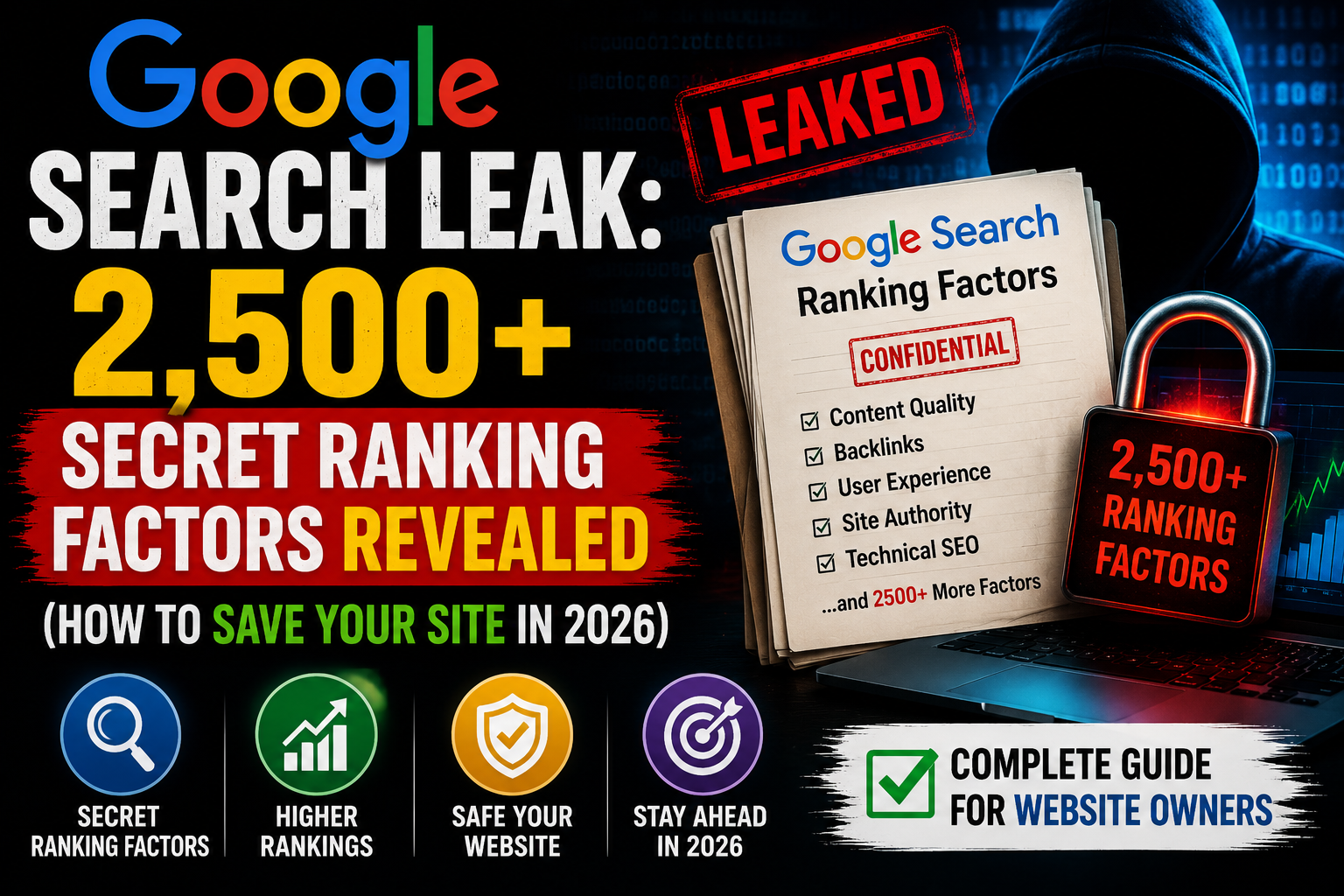
For years, Google told us that “Domain Authority” isn’t a thing. They told us they don’t use Chrome data to rank websites. They even told us that click-through rates don’t directly influence your position. Well, in 2026, the mask has finally fallen. A massive leak of 2,500+ internal API documents has revealed the “Blueprints” of how Google actually ranks content.
At Capdigitals, we spent the last week digging through these thousands of pages of leaked code. If you are a blogger, a business owner, or an SEO expert, the rules of the game just changed overnight. Here is the unfiltered truth about what actually matters for your rankings in 2026 and how you can stay ahead of the curve.
1. The Death of the “Keyword Stuffing” Era
The leak confirms something we always suspected: Google doesn’t care about your keyword density as much as it cares about “Site Embeddings.” The algorithm now looks at your entire website’s “Focus Score.” If you write about ‘Digital Marketing’ today and ‘Cooking Recipes’ tomorrow, Google’s internal siteRadius metric will flag your site as “unfocused,” and your rankings will tank across all topics.
The Fix: Stay in your lane. If Capdigitals is about digital growth, every single article needs to revolve around that core theme. Topical authority is no longer a suggestion; it’s a hard-coded requirement.
2. Navboost & Chrome Data: The Secret Spy
This is the biggest bombshell. The leaked documents mention “Navboost” and “chromeInTotal.” This confirms that Google tracks how users interact with your site through the Chrome browser. If people land on your site and immediately “pogo-stick” back to the search results, Google marks your content as low quality, regardless of how many backlinks you have.
What matters now:
- Dwell Time: How long a user stays on your page.
- Clickstream: What the user does after clicking your link.
- Brand Searches: How many people actually type “Capdigitals” into the search bar.
3. The “Small Site” Penalty vs. Brand Authority
The leak revealed a specific attribute called “isSmallPersonalSite.” It appears Google has a way to categorize smaller blogs differently from big brands. While this sounds unfair, it actually gives us a roadmap. To move out of the “small site” trap, you need to build Brand Signals.
Google looks for “Entity” data. Do you have a verified LinkedIn? Is your brand mentioned on news sites? Does your author have an authorReputationScore? In 2026, Google isn’t just ranking pages; it’s ranking reputations.
4. Backlinks: Quality Over Everything (Literally)
The documents show that Google specifically tags links from “High-Quality, Newsy Sites.” A single link from a site like Forbes or a top-tier industry blog is worth more than 1,000 links from random “Guest Post” farms. In fact, the leak suggests that Google might be ignoring links that come from irrelevant content entirely.
5. 2026 SEO Strategy: Your 3-Step Action Plan
So, how do you survive this leak and grow Capdigitals? Here is the strategy we are implementing right now:
Step A: Focus on “User Intent” Over Keywords
Stop writing for bots. Write for the person sitting behind the screen. If your article doesn’t solve their problem in the first 2 paragraphs, they will leave, and your Chrome-based engagement metrics will kill your ranking.
Step B: Build Author E-E-A-T⊂
Every post on Capdigitals must have a detailed author bio with links to professional social profiles. Google is looking for “WebrefMentionRatings”—they want to see that the person writing the content is a real human expert with a history in the niche.
Step C: Optimize for “Search Satisfaction”
Include interactive elements. Use tables, bullet points, and short, punchy sentences. The easier your content is to consume, the longer the user stays, and the higher your Navboost score goes.
Final Thoughts: The Human Advantage
The biggest takeaway from the 2,500+ leaked factors is that Google is getting better at spotting “fake” authority. AI-generated fluff that says a lot without saying anything is being filtered out. In 2026, Human Experience is the ultimate ranking factor.
At Capdigitals, we believe the future of SEO belongs to those who build genuine brands and provide real value. The blueprints are out, the secrets are revealed—now it’s time to out-work the algorithm.
Adeeb Malik is the founder of Capdigitals, where he shares practical insights on digital marketing, blogging, SEO, and online earning. He focuses on simplifying complex strategies into easy, actionable steps for beginners. The content is based on research, real-world concepts, and learning resources. All information is for educational purposes only and does not constitute financial or business advice.