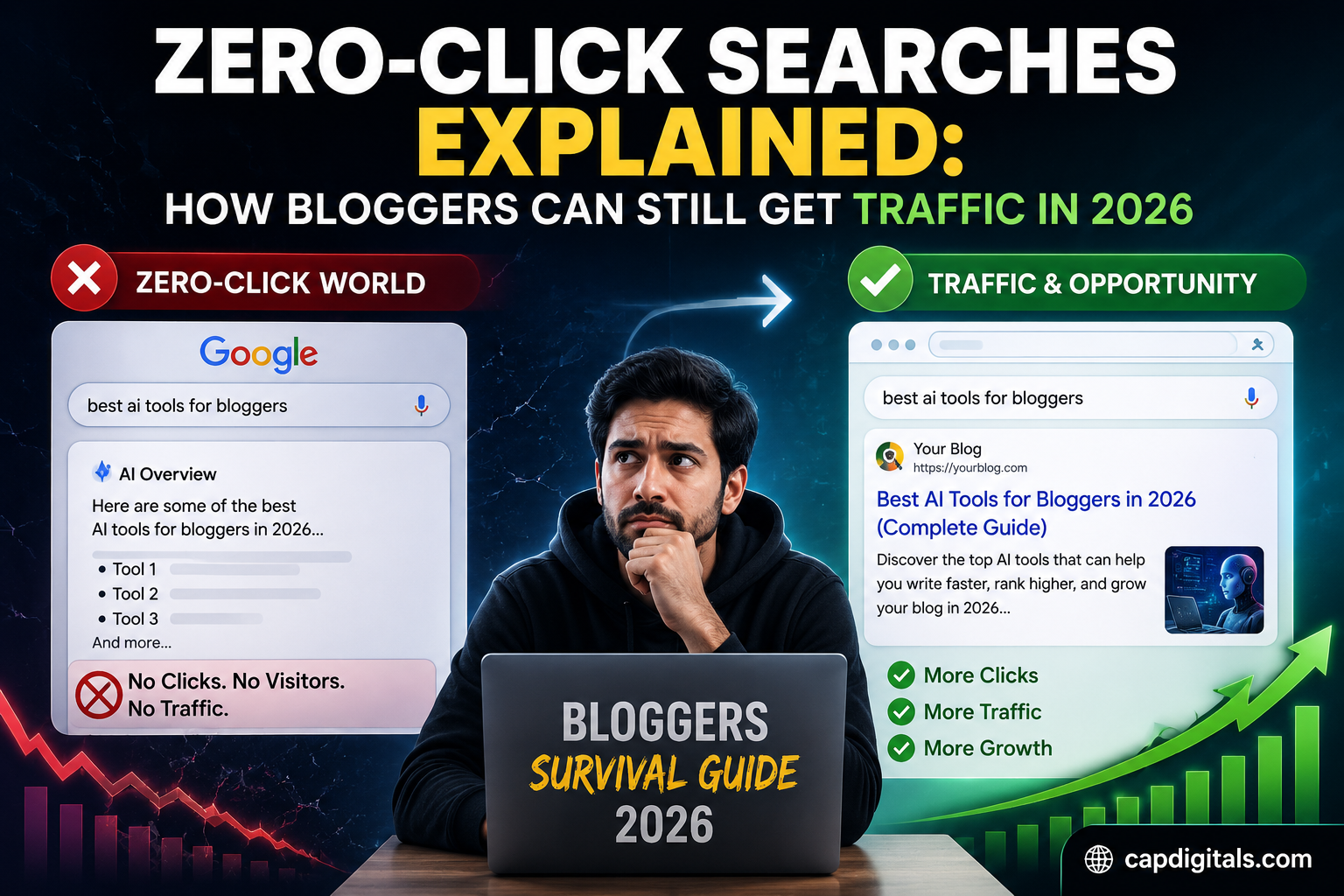
Something strange has started happening on Google.
People are searching more than ever before, but many websites are quietly losing clicks.
A few years ago, if someone searched “best AI tools,” “how to start blogging,” or “latest SEO tips,” they would usually open multiple websites and spend time reading different articles.
But in 2026, that behavior is changing very fast.
Today, users often get their answers directly on the search results page itself. Sometimes Google’s AI Overview answers the question instantly. Sometimes SearchGPT-style search experiences summarize everything before users even visit a website.
And because of that, thousands of bloggers are now asking the same uncomfortable question:
“Is organic traffic slowly dying?”
Honestly, the fear is real.
Many small publishers have already noticed lower click-through rates even when their rankings still appear on page one. Some websites are getting impressions but fewer actual visitors. Others are seeing traffic spikes disappear overnight after AI-generated search summaries appear.
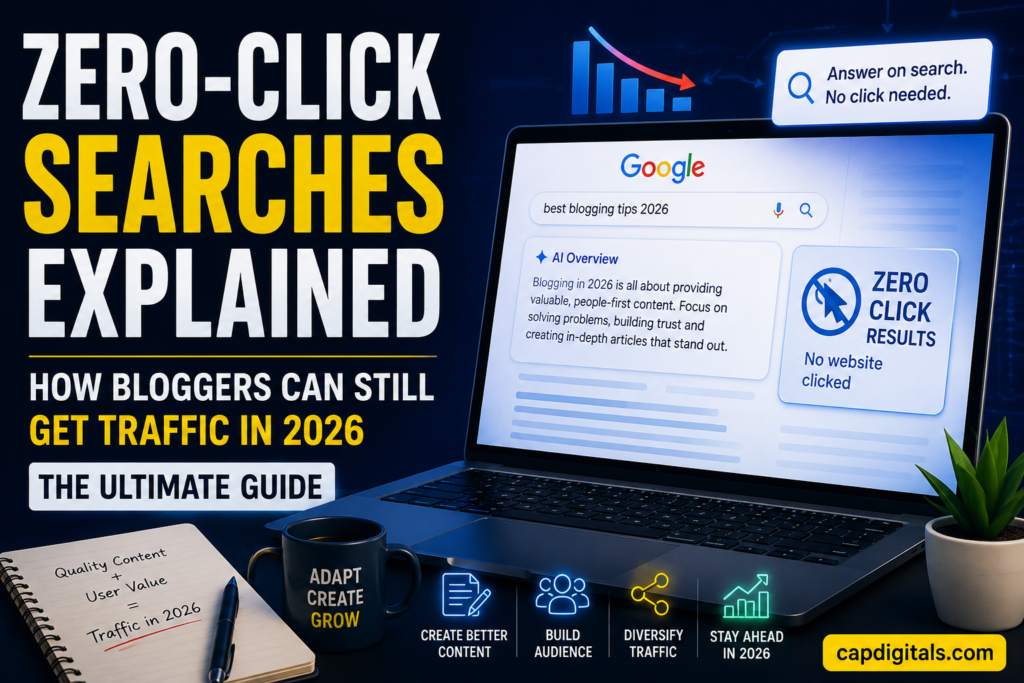
This is exactly why the term “Zero-Click Searches” has become one of the biggest discussions in the SEO world right now.
What Exactly Are Zero-Click Searches?
A zero-click search happens when a user searches for something on Google but never clicks on any website.
Instead, the answer is shown directly inside:
- Google AI Overviews
- Featured snippets
- Knowledge panels
- Instant answer boxes
- AI-generated summaries
- SearchGPT-style conversational search
For users, this feels convenient.
But for bloggers and publishers, this changes everything.
Imagine spending six hours writing a detailed article only for Google to summarize the answer directly on top of search results. The user gets the information instantly and never visits your site.
That is the core reason why so many website owners are nervous in 2026.
Why Google Is Moving Towards AI Search
To understand the future of blogging, we first need to understand why Google itself is changing.
The biggest reason is simple:
User behavior has changed.
People now expect faster answers.
Social media apps like TikTok, Instagram Reels, YouTube Shorts and AI chatbots have reduced people’s patience dramatically. Users no longer want to open ten websites just to find one small answer.
Google knows this very well.
That is why AI-powered search experiences are growing aggressively.
In many ways, Google is trying to compete directly with platforms like
[OpenAI](https://openai.com?utm_source=chatgpt.com) and AI-based conversational search tools.
The problem is that this shift completely changes how websites receive traffic.
The Real Impact on Bloggers and Website Owners
A lot of people online are saying:
“Blogging is dead.”
But honestly, that statement is exaggerated.
What is actually happening is much more complicated.
Low-quality blogging is definitely struggling.
Websites built only for:
- copy-paste content
- keyword stuffing
- generic AI spam
- thin affiliate pages
- mass-produced low-value articles
are losing visibility faster than before.
However, websites that provide:
- real experiences
- deep analysis
- human insights
- strong opinions
- helpful explanations
- unique formatting
still have a future.
In fact, many experienced SEO professionals believe authority websites may become even more valuable after AI search becomes mainstream.
Google Doesn’t Need More Content — It Needs Better Content
This is the part many beginners still do not fully understand.
The internet already has billions of articles.
Google does not need another generic article titled:
“Top 10 Blogging Tips.”
There are already millions of those.
What Google is now rewarding more aggressively is:
- topical authority
- real expertise
- experience-based writing
- clear user value
- trustworthy information
- strong site structure
This is one reason why many random websites lost traffic after recent Google updates while niche authority sites survived.
Internal Linking Is Becoming More Important Than Ever
One thing many new bloggers ignore is internal linking.
Google no longer evaluates articles completely in isolation. It now tries to understand whether an entire website deeply covers a topic.
For example, if your website talks about AI search, SEO and blogging future, Google expects interconnected content.
That is why websites like
[Capdigitals](https://capdigitals.com?utm_source=chatgpt.com) should build strong topic clusters instead of random disconnected articles.
Related Articles:
SearchGPT vs Google Search 2026
Google Search Leak Ranking Factors 2026
Best AI Tools to Make Money Online 2026
This type of structure helps Google understand your website’s expertise.
So, Can Bloggers Still Survive in 2026?
Yes — but not in the same way as before.
The “easy traffic era” is slowly disappearing.
A few years ago, people could publish:
- basic tutorials
- rewritten articles
- simple list posts
- low-effort SEO pages
and still rank.
That strategy is becoming weaker every year.
In 2026, successful bloggers are focusing more on:
- branding
- authority
- trust
- community
- unique insights
- real experiences
This is exactly why personal-style content is becoming more powerful again.
What Smart Bloggers Are Doing Right Now
1. Building Topic Authority
Instead of writing about random subjects, successful websites are building complete content ecosystems around one niche.
For example:
- AI Search
- SEO
- Blogging Future
- Digital Marketing
- Make Money Online
all naturally connect together.
2. Writing Human-First Content
Readers are becoming smarter at detecting robotic writing.
People now prefer:
- opinions
- stories
- examples
- real observations
- natural language
over lifeless SEO articles.
3. Diversifying Traffic Sources
Depending only on Google is becoming risky.
Smart creators are now building traffic from:
- YouTube
- Email newsletters
- Telegram communities
- Google Discover
- Social media
GEO vs SEO: The New Reality
A new term has quietly started growing in the search industry:
GEO — Generative Engine Optimization.
Traditional SEO focused on ranking webpages.
GEO focuses on making your content visible inside AI-generated answers.
This may become one of the most important digital marketing skills over the next few years.
Websites that provide:
- clear information
- accurate data
- structured formatting
- authority signals
- trustworthy writing
are more likely to be referenced by AI search systems.
The Future of Blogging Is Smaller — But Stronger
One uncomfortable truth is becoming obvious:
Millions of low-quality websites may disappear over the next few years.
But that does not mean blogging itself will disappear.
Instead, the internet may simply become more competitive and more quality-focused.
The creators who survive will likely be the ones who:
- build real brands
- provide genuine value
- understand user intent
- adapt quickly
- write for humans first
Ironically, AI search may actually increase the value of truly human content.
Final Thoughts
Zero-click searches are real.
AI-powered search is growing rapidly.
And yes, blogging is changing faster than most people expected.
But this is not necessarily the end of blogging.
It may simply be the end of low-effort blogging.
The websites that focus on originality, trust, authority and user value still have enormous opportunities ahead.
In 2026, surviving online is no longer only about ranking higher on Google.
It is about becoming valuable enough that both humans and AI systems trust your content.
That is the real future of digital publishing.
Further Reading:
Best Free AI Tools to Make Money Online
Earn Money Online India 2026
Freelancing vs Blogging in 2026

Adeeb Malik is the founder of Capdigitals, where he shares practical insights on digital marketing, blogging, SEO, and online earning. He focuses on simplifying complex strategies into easy, actionable steps for beginners. The content is based on research, real-world concepts, and learning resources. All information is for educational purposes only and does not constitute financial or business advice.